Showing posts with label art techniques. Show all posts

Sunday, 25 August 2013

Seeing the world one drawing at a time

Two of us (Fiona and Tina) are flying to Italy next week to take part in 'Tuscan Landscape', an urban sketchers' workshop in the ancient city of Volterra, based in the beautiful Villa Le Guadalupe.


We will be sketching and seeing our surroundings 'one drawing at a time' in keeping with the urban sketchers' manifesto (see below). Their philosophy of truth in looking, capturing and sharing is one that chimes resoundingly with all us who sketch and paint. We'll also be sketching the magnificent Etruscan and Roman remains, working expressively and experimentally exploring interrupted lines and fragments.  We're very much looking forward to sketching in such a wonderful environment and meeting the interesting people who are also attending. In fact we're so excited to be going, and to be going together, that we've been quietly delirious for weeks.

I attended a similar workshop in 2011 and wrote about it in my personal blog here and here.

USK Manifesto

1. We draw on location, indoors or out, capturing what we see from direct observation. 2. Our drawings tell the story of our surroundings, the places we live and where we travel. 3. Our drawings are a record of time and place. 4. We are truthful to the scenes we witness. 5. We use any kind of media and cherish our individual styles. 6. We support each other and draw together. 7. We share our drawings online. 8. We show the world, one drawing at a time.

Reading this manifesto earlier this summer, I was spurred on to sketch even more regularly. I've therefore had a very pleasant summer sitting outside cafes and in pub gardens, consuming excellent coffees, beer and various cakes, pies etc, sketching whatever I could see in front of me. I made my own sketchbook, taking an old poetry textbook and altering the pages by staining them with inks, household emulsion and gesso or including extra pages, mostly old monoprints, textured papers etc. Every page is different and the challenge has been to work on whatever surface presents itself next, no matter the subject, and no matter how difficult! I'll post about how I made the book in another post later. 

All sketches have been done on location; on some of the pages, colour and texture has been added later. Here are a few examples:


Victorian pub 'the Rising Sun'; watercolour, ink and gouache on yellow household emulsion paint (Fiona)

16thc coaching inn 'The Crown'; gouache and inks on ink-spattered text (Fiona)

fields and sky at Compton Verney; watercolour and gesso (Fiona)

stone sculpures at Tong church; inks on old monoprint (Fiona)

Tong church and village; watercolour, inks and white marker pen on household emulsion (Fiona)

light and dark; inks, crayon and gouache on household emulsion (Fiona)

watercolour, gouache and inks on old monoprint (Fiona)

Saturday, 17 August 2013

summer sketchbooks 2

Sue came back from St. Ives with sketchbooks filled with ink and watercolour studies. Her love for the town and surroundings began when she first went there on holiday as a teenager. Her sketches show great sensitivity of touch and deep affection for the landscape. All her sketchbook work is done from direct observation en plein air.

Here are some of her pen and ink drawings of boats in the harbour:


Sunday, 20 January 2013

drawing as stitch

 
Here are some stitched drawings by Tina. Two are based on everyday scenes observed in her local market. The other was sketched (as a passenger!) on a long car journey.

Tina likes to use a continuous line in some of her drawings. By keeping the pencil on the paper, the line becomes free and the relationship between the subject and the observer are somehow brought intimately together. The line connects elements in the composition, relates disparate and similar subjects, sometimes identifying and repeating patterns, other times contrasting shapes and textures, always drawing the eye round the canvas, exploring how objects relate to one another both in the drawing and in the life Tina observes so beautifully around her.

This is a technique which crosses so-called artistic boundaries, and lends itself perfectly to interpretation through stitch. These drawings have all been resolved through the medium of a sewing machine and plain black thread on cotton.

fish stall, market; black thread on cotton (Tina)
egg stall, market; black thread on cotton (Tina)

a long drive; black thread on cotton (Tina)

Monday, 10 December 2012

drawing as printing (2)


Following on from a previous post, 'drawing as printing', I said I would return to the topic to describe the materials and process with pictures.
 
Materials:

-2 pieces of cartridge or drawing paper. I cut mine to approx 8" x 8".
-soft pastels or chalk in pale shades
-oil pastels
-drawing tools e.g. ball-point pen, hard pencil, chopstick, stick, the wrong end of a brush.. experiment with mark-making using different tools.


 1) using soft pastels, cover one of your pieces of paper entirely with colour. It doesn't matter which colours you choose.


2) choose some oil pastels and steadily rub them on top of the soft pastel surface until the whole surface is covered. A fairly generous hand is required. Irregular shapes will be most effective, the more random the better. Overlap the colours to soften transitions and mix colours on the paper. Here I've chosen 5 colours: dark blue, pale blue, lemon, ochre and a mid-green.


3) On a flat surface, take your coloured paper and place it face-down onto a clean piece of paper.

4) At this stage you can either take some time to experiment with different drawing tools or choose a subject/pattern and plunge right in. 


5) Taking a page from my sketchbook as inspiration, I choose to draw the shell on the right.


6) Working into the back of my coloured paper, I use a ball-point pen to do a simple outline drawing of the shell based on the sketchbook image. A firm line and simplified form works best. Here I've varied the weight of the line slightly to emphasise the basic shape.


7) Happy with the drawing, now I'm ready to see what's been happening underneath. I peel back the paper to reveal an oil pastel monoprint. You can see how the random colour placement magically gives form and interest to a fairly ordinary outline drawing.


 The negative image is also interesting....


...but if you don't want to keep it, then you can continue using the coloured 'plate' until exhausted.


Here's another monoprint taken from the same coloured plate, this time of dried honesty seedheads. The drawn lines as less distinct in places but the image still works.


The negative image is now breaking up, but could make a very interesting texture to work into as it is, or to cut up and use as collage, or to paint over... wherever your creativity takes you. Never throw anything away!


If you experiment with this technique we'd love to see your work. Post a pic on your own blog and leave a comment here with the link. We'll drop by and visit.


Sunday, 2 December 2012

drawing as printing

Before I post some more catching-up with our sketching so far year, I've been asked about the drawing in the background of the blog.

It is a quick outline sketch by Tina (whilst chatting!) of some roses and chrysanthemums. The mark-making is soft and expressive and moves smoothly through different blues and greens. The result is beautifully fresh and spontaneous.


The drawing is worked by pressing a drawn line (with a pencil, chopstick, biro, stick...) firmly onto the wrong side of a paper preprepared on the other side with chalk pastel and oil crayon, then placed face-down on a clean piece of paper on which the image appears (it's simpler to do than it sounds), creating a kind of dry monoprint. The oil pastel lifts from the chalk/soft patel ground and transfers to the clean piece of paper. It's a very satisfying technique and always fun to do whether you're a beginner or more experienced, with the added dimension of surprise.. you are never quite sure how it's going to turn out. It also has the added bonus of producing both a positive and a negative image.


flowers, positive
flowers, negative


The drawings can stand alone as they are, can be used as a basis for further work in oils, or can be developed with other media; for example, with watercolour washes the oil pastel acts as a resist. 

If you're not confident about drawing as Tina did directly from a subject, then you can also use this technique with photographs or tracings to excellent effect.

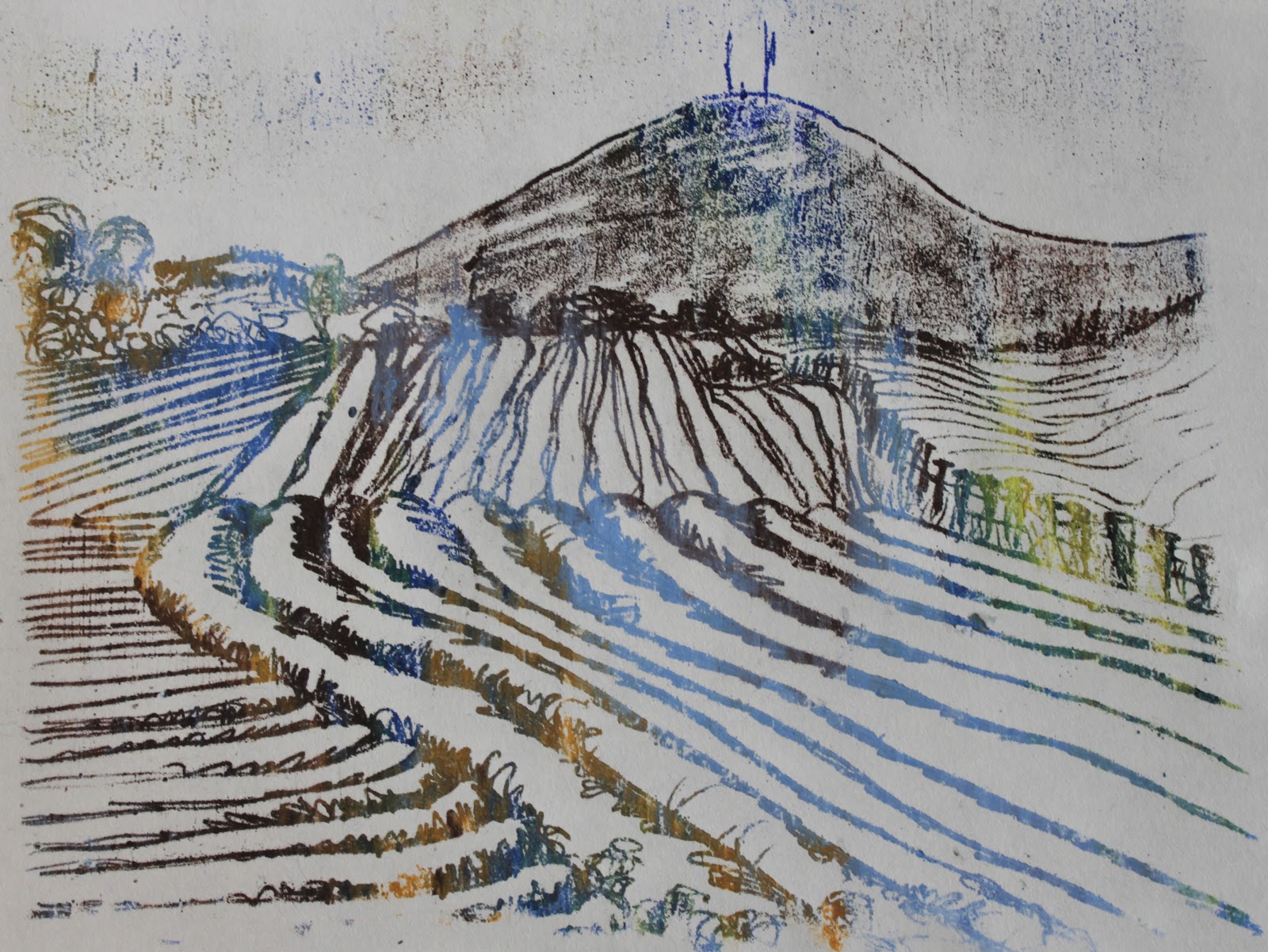
Here's a different subject by Fiona this time, based on plein air sketchbook work of a ploughed field, drawn here using a biro through a soft pastel and oil pastel 'plate' as above.


landscape, positive
landscape, negative

I'll post a 'how to' with details of materials and photos of the process later this week.


Related Posts Plugin for WordPress, Blogger...