I went to the North Lakes in July to participate in a workshop led by John Threlfall, organised by the Field Studies Council at their centre on Blencathra.
John is an outstanding contemporary artist, committed to the drawing and painting of wild creatures on location from direct observation. In his own words he witnesses the natural world through pencil and paint. The books of his paintings are annotated descriptively and poetically, every wild creature painted within its own landscape.
He currently has a solo show exhibiting at the Donald Watson Gallery in Aberlady, near Edinburgh. His work will also be on display at the Society of Wildlife Artists annual show at the Mall Galleries in London in Oct/Nov this year.
As well as all of that he is a very good teacher.
The workshop took place over 4 days in the most spectacular location of The North Lakes near Keswick. An extended spell of high pressure meant clear skies and warm temperatures all week.
Drawing birds is a challenging thing to attempt. They move, they swim, they hide, they fly away. John stressed the importance of close observation in order to identify characteristic features and gestures, and above all, patience. We all applied ourselves and had a very rewarding and enjoyable week, learning as we sketched.
In four days sketching, I used up a pad of A2 cartridge paper, 4 pencils from tip to stump, trashed a portable chair, ripped the buckle from a bag, and wore out two old shirts. (Also a fair bit of strong coffee, gin and tonic, and white wine, but that's another story)
A selection of sketches of canada and greylag geese, attempting to capture characteristic gestures and positions (Fiona):
Showing posts with label drawing. Show all posts
Tuesday, 5 August 2014
Drawing wild birds
Labels:
bird,
Blencathra,
canada goose,
Derwent Water,
drawing,
en plein air,
Field Studies Council,
geese,
greylag goose,
John Threlfall,
Keswick,
Lake District,
pencil,
sketch,
wildlife
Sunday, 27 July 2014
Exhibition in Wales; 'Myself'
Jane's submission for the Tabernacle Open art competition at MOMA has been accepted. It has been awarded Highly Commended. Very exciting and well-deserved.
The theme given was 'Myself'. Jane worked in charcoal, linseed oil and acrylic on board to produce a very contemplative and moving self-portrait.
The exhibition runs from 12 July to 30 August 2014 at MOMA in Machynlleth, Wales (link above)
The theme given was 'Myself'. Jane worked in charcoal, linseed oil and acrylic on board to produce a very contemplative and moving self-portrait.
The exhibition runs from 12 July to 30 August 2014 at MOMA in Machynlleth, Wales (link above)
Tuesday, 24 September 2013
Garden shed
![]() |
| garden shed from Fiona's garden; inks and watercolour (Jane) |
Jane was taken by this particular shed, and came round to sketch it before we put up another in front of it (in order to decant the contents of our broken-down shed so that we can patch it up in turn, so the cycle continues..). In the spontaneity of her brushstrokes and the discrete use of the startling blue, she has captured the wildness of the undergrowth, and the dappled light as it filters through the tall trees, as well as the unique character of the garden shed.
Labels:
drawing,
en plein air,
garden,
inks,
shed,
sketch,
sketchbook,
summer,
watercolour
Sunday, 25 August 2013
Seeing the world one drawing at a time
Two of us (Fiona and Tina) are flying to Italy next week to take part in 'Tuscan Landscape', an urban sketchers' workshop in the ancient city of Volterra, based in the beautiful Villa Le Guadalupe.
We will be sketching and seeing our surroundings 'one drawing at a time' in keeping with the urban sketchers' manifesto (see below). Their philosophy of truth in looking, capturing and sharing is one that chimes resoundingly with all us who sketch and paint. We'll also be sketching the magnificent Etruscan and Roman remains, working expressively and experimentally exploring interrupted lines and fragments. We're very much looking forward to sketching in such a wonderful environment and meeting the interesting people who are also attending. In fact we're so excited to be going, and to be going together, that we've been quietly delirious for weeks.
I attended a similar workshop in 2011 and wrote about it in my personal blog here and here.
1. We draw on location, indoors or out, capturing what we see from direct observation.
2. Our drawings tell the story of our surroundings, the places we live and where we travel.
3. Our drawings are a record of time and place.
4. We are truthful to the scenes we witness.
5. We use any kind of media and cherish our individual styles.
6. We support each other and draw together.
7. We share our drawings online.
8. We show the world, one drawing at a time.
Reading this manifesto earlier this summer, I was spurred on to sketch even more regularly. I've therefore had a very pleasant summer sitting outside cafes and in pub gardens, consuming excellent coffees, beer and various cakes, pies etc, sketching whatever I could see in front of me. I made my own sketchbook, taking an old poetry textbook and altering the pages by staining them with inks, household emulsion and gesso or including extra pages, mostly old monoprints, textured papers etc. Every page is different and the challenge has been to work on whatever surface presents itself next, no matter the subject, and no matter how difficult! I'll post about how I made the book in another post later.
All sketches have been done on location; on some of the pages, colour and texture has been added later. Here are a few examples:
We will be sketching and seeing our surroundings 'one drawing at a time' in keeping with the urban sketchers' manifesto (see below). Their philosophy of truth in looking, capturing and sharing is one that chimes resoundingly with all us who sketch and paint. We'll also be sketching the magnificent Etruscan and Roman remains, working expressively and experimentally exploring interrupted lines and fragments. We're very much looking forward to sketching in such a wonderful environment and meeting the interesting people who are also attending. In fact we're so excited to be going, and to be going together, that we've been quietly delirious for weeks.
I attended a similar workshop in 2011 and wrote about it in my personal blog here and here.
USK Manifesto
Reading this manifesto earlier this summer, I was spurred on to sketch even more regularly. I've therefore had a very pleasant summer sitting outside cafes and in pub gardens, consuming excellent coffees, beer and various cakes, pies etc, sketching whatever I could see in front of me. I made my own sketchbook, taking an old poetry textbook and altering the pages by staining them with inks, household emulsion and gesso or including extra pages, mostly old monoprints, textured papers etc. Every page is different and the challenge has been to work on whatever surface presents itself next, no matter the subject, and no matter how difficult! I'll post about how I made the book in another post later.
All sketches have been done on location; on some of the pages, colour and texture has been added later. Here are a few examples:
![]() |
| Victorian pub 'the Rising Sun'; watercolour, ink and gouache on yellow household emulsion paint (Fiona) |
![]() |
| 16thc coaching inn 'The Crown'; gouache and inks on ink-spattered text (Fiona) |
![]() |
| fields and sky at Compton Verney; watercolour and gesso (Fiona) |
![]() |
| stone sculpures at Tong church; inks on old monoprint (Fiona) |
![]() |
| Tong church and village; watercolour, inks and white marker pen on household emulsion (Fiona) |
![]() |
| light and dark; inks, crayon and gouache on household emulsion (Fiona) |
![]() |
| watercolour, gouache and inks on old monoprint (Fiona) |
Saturday, 17 August 2013
summer sketchbooks 2
Sue came back from St. Ives with sketchbooks filled with ink and watercolour studies. Her love for the town and surroundings began when she first went there on holiday as a teenager. Her sketches show great sensitivity of touch and deep affection for the landscape. All her sketchbook work is done from direct observation en plein air.
Here are some of her pen and ink drawings of boats in the harbour:
![]() |
Tuesday, 30 July 2013
summer sketchbooks
Some extracts from summer sketchbooks, with more to follow over the next few weeks...
An ever-stretching wild river meadow of dandelions with fields of yellow oil-seed rape beyond, sweltering in the golden light of mid-summer, the river deep and fast behind me.
This was worked up from an in-situ sketch as preparatory work for a painting on canvas. I've started to work in a bigger format (A3 sketchbook) in an attempt to ease the transition from living in my sketchbook to stand-alone work.
| Severn valley, Shropshire; 82cm x 30cm; inks, watercolour & enamels on gesso (Fiona) |
| sunflower; 30cm x 41cm; inks & conte crayon (Fiona) |
| bleached treetrunk, Himley Hall; 30cm x 41cm; inks, aquarelle & conte crayon (Fiona) |
I sketched this old dead tree trunk in the teeth of a very brisk north wind, so worked quickly with a broad bamboo pen and various inks, flinging it all around in order to complete the entire sketch in about 15 minutes. That way I could get back quickly into the warm sunshine... but also a great way to free up a drawing and work expressively.
Labels:
art,
drawing,
en plein air,
enamels,
gesso,
inks,
landscape,
mixed media,
painting,
paper,
pastel,
pen and ink,
shropshire,
sketchbook,
sketching,
summer,
sunflower,
tree,
watercolour
Sunday, 20 January 2013
drawing as stitch
Tina likes to use a continuous line in some of her drawings. By keeping the pencil on the paper, the line becomes free and the relationship between the subject and the observer are somehow brought intimately together. The line connects elements in the composition, relates disparate and similar subjects, sometimes identifying and repeating patterns, other times contrasting shapes and textures, always drawing the eye round the canvas, exploring how objects relate to one another both in the drawing and in the life Tina observes so beautifully around her.
This is a technique which crosses so-called artistic boundaries, and lends itself perfectly to interpretation through stitch. These drawings have all been resolved through the medium of a sewing machine and plain black thread on cotton.
![]() | |
| fish stall, market; black thread on cotton (Tina) |
![]() |
| egg stall, market; black thread on cotton (Tina) |
![]() |
| a long drive; black thread on cotton (Tina) |
Sunday, 13 January 2013
winter trees
Jane draws with a light touch and great sensitivity.
Here she has produced a charcoal drawing of birds fluttering through winter branches. She has tackled a difficult subject and unusual perspective and produced a vision of light that is stark and skeletal in places, and almost transparent in others, all beautifully observed. Her skillful drawing of bare branches and birds in flight is exquisite, producing an almost meditative effect.
Like many wild places in the area, Baggeridge Country Park is reclaimed from a hard-working industrial past, but now provides interesting walks and activities as well as varied habitats for plants, birds and animals.
The finished drawing is based on Jane's direct observation of the trees where she walks her dog almost every day. Her passion for the place is evident in the intensity of her vision.
Here she has produced a charcoal drawing of birds fluttering through winter branches. She has tackled a difficult subject and unusual perspective and produced a vision of light that is stark and skeletal in places, and almost transparent in others, all beautifully observed. Her skillful drawing of bare branches and birds in flight is exquisite, producing an almost meditative effect.
Like many wild places in the area, Baggeridge Country Park is reclaimed from a hard-working industrial past, but now provides interesting walks and activities as well as varied habitats for plants, birds and animals.
The finished drawing is based on Jane's direct observation of the trees where she walks her dog almost every day. Her passion for the place is evident in the intensity of her vision.
| winter trees; charcoal on paper, 42 x 60 cm/16.5" x 23.5", Jane |
Tuesday, 1 January 2013
daily practice
I'm not sure if we at 'drawing allowed' have any new year resolutions other than to continue to make time for our own creative practice and to share it with others.
Before the holidays I decided to make time to follow Chris Carter's online drawing exercises. Chris is a very experienced and talented artist who has a strong and generous commitment to sharing her skills and experience through her blogs. She posts three times a week with quick tasks, always with an explanation of what to do and why it's important.
For example: Her first exercise is about getting into the habit of sketching for 5 minutes every day. It doesn't sound a lot, but we all know how hard that is sometimes. But if you follow her advice you'll find yourself doing 5 minute sketches wherever you are whatever your circumstances, and all without even thinking about it. Before you know it, you'll have a sketchbook full of sketches, inspiration and ideas for further development.
Find Chris's exercises here.
I hope you find them as useful as I have.
A prosperous and creative New Year to all. And for our italian followers.. auguri e tante belle cose per l'anno nuovo.
Before the holidays I decided to make time to follow Chris Carter's online drawing exercises. Chris is a very experienced and talented artist who has a strong and generous commitment to sharing her skills and experience through her blogs. She posts three times a week with quick tasks, always with an explanation of what to do and why it's important.
For example: Her first exercise is about getting into the habit of sketching for 5 minutes every day. It doesn't sound a lot, but we all know how hard that is sometimes. But if you follow her advice you'll find yourself doing 5 minute sketches wherever you are whatever your circumstances, and all without even thinking about it. Before you know it, you'll have a sketchbook full of sketches, inspiration and ideas for further development.
Find Chris's exercises here.
I hope you find them as useful as I have.
A prosperous and creative New Year to all. And for our italian followers.. auguri e tante belle cose per l'anno nuovo.
Monday, 10 December 2012
drawing as printing (2)
Following on from a previous post, 'drawing as printing', I said I would return to the topic to describe the materials and process with pictures.
Materials:
-2 pieces of cartridge or drawing paper. I cut mine to approx 8" x 8".
-soft pastels or chalk in pale shades
-oil pastels
-drawing tools e.g. ball-point pen, hard pencil, chopstick, stick, the wrong end of a brush.. experiment with mark-making using different tools.
1) using soft pastels, cover one of your pieces of paper entirely with colour. It doesn't matter which colours you choose.
2) choose some oil pastels and steadily rub them on top of the soft pastel surface until the whole surface is covered. A fairly generous hand is required. Irregular shapes will be most effective, the more random the better. Overlap the colours to soften transitions and mix colours on the paper. Here I've chosen 5 colours: dark blue, pale blue, lemon, ochre and a mid-green.
3) On a flat surface, take your coloured paper and place it face-down onto a clean piece of paper.
4) At this stage you can either take some time to experiment with different drawing tools or choose a subject/pattern and plunge right in.
5) Taking a page from my sketchbook as inspiration, I choose to draw the shell on the right.
6) Working into the back of my coloured paper, I use a ball-point pen to do a simple outline drawing of the shell based on the sketchbook image. A firm line and simplified form works best. Here I've varied the weight of the line slightly to emphasise the basic shape.
7) Happy with the drawing, now I'm ready to see what's been happening underneath. I peel back the paper to reveal an oil pastel monoprint. You can see how the random colour placement magically gives form and interest to a fairly ordinary outline drawing.
The negative image is also interesting....
...but if you don't want to keep it, then you can continue using the coloured 'plate' until exhausted.
Here's another monoprint taken from the same coloured plate, this time of dried honesty seedheads. The drawn lines as less distinct in places but the image still works.
The negative image is now breaking up, but could make a very interesting texture to work into as it is, or to cut up and use as collage, or to paint over... wherever your creativity takes you. Never throw anything away!
If you experiment with this technique we'd love to see your work. Post a pic on your own blog and leave a comment here with the link. We'll drop by and visit.
Labels:
art,
art techniques,
chalk,
drawing,
honesty,
how to,
mixed media,
monoprint,
monotype,
oil pastel,
pastel,
printmaking,
seedhead,
shell,
sketch,
sketchbook,
sketching,
soft pastel
Sunday, 9 December 2012
Jane's life drawing
This week, Jane has developed a life drawing into an impressive painting full of character, light and haunting shadows. She has used expansive and confident gestural marks, complimentary colour and a vibrant composition to perfectly capture facial expression and the relaxed pose. She has also achieved a remarkable likeness.
Labels:
acrylic,
art,
chiaroscuro,
drawing,
life drawing,
light,
painting,
shadow
Sunday, 2 December 2012
drawing as printing
Before I post some more catching-up with our sketching so far year, I've been asked about the drawing in the background of the blog.
It is a quick outline sketch by Tina (whilst chatting!) of some roses and chrysanthemums. The mark-making is soft and expressive and moves smoothly through different blues and greens. The result is beautifully fresh and spontaneous.
The drawing is worked by pressing a drawn line (with a pencil, chopstick, biro, stick...) firmly onto the wrong side of a paper preprepared on the other side with chalk pastel and oil crayon, then placed face-down on a clean piece of paper on which the image appears (it's simpler to do than it sounds), creating a kind of dry monoprint. The oil pastel lifts from the chalk/soft patel ground and transfers to the clean piece of paper. It's a very satisfying technique and always fun to do whether you're a beginner or more experienced, with the added dimension of surprise.. you are never quite sure how it's going to turn out. It also has the added bonus of producing both a positive and a negative image.
The drawings can stand alone as they are, can be used as a basis for further work in oils, or can be developed with other media; for example, with watercolour washes the oil pastel acts as a resist.
If you're not confident about drawing as Tina did directly from a subject, then you can also use this technique with photographs or tracings to excellent effect.
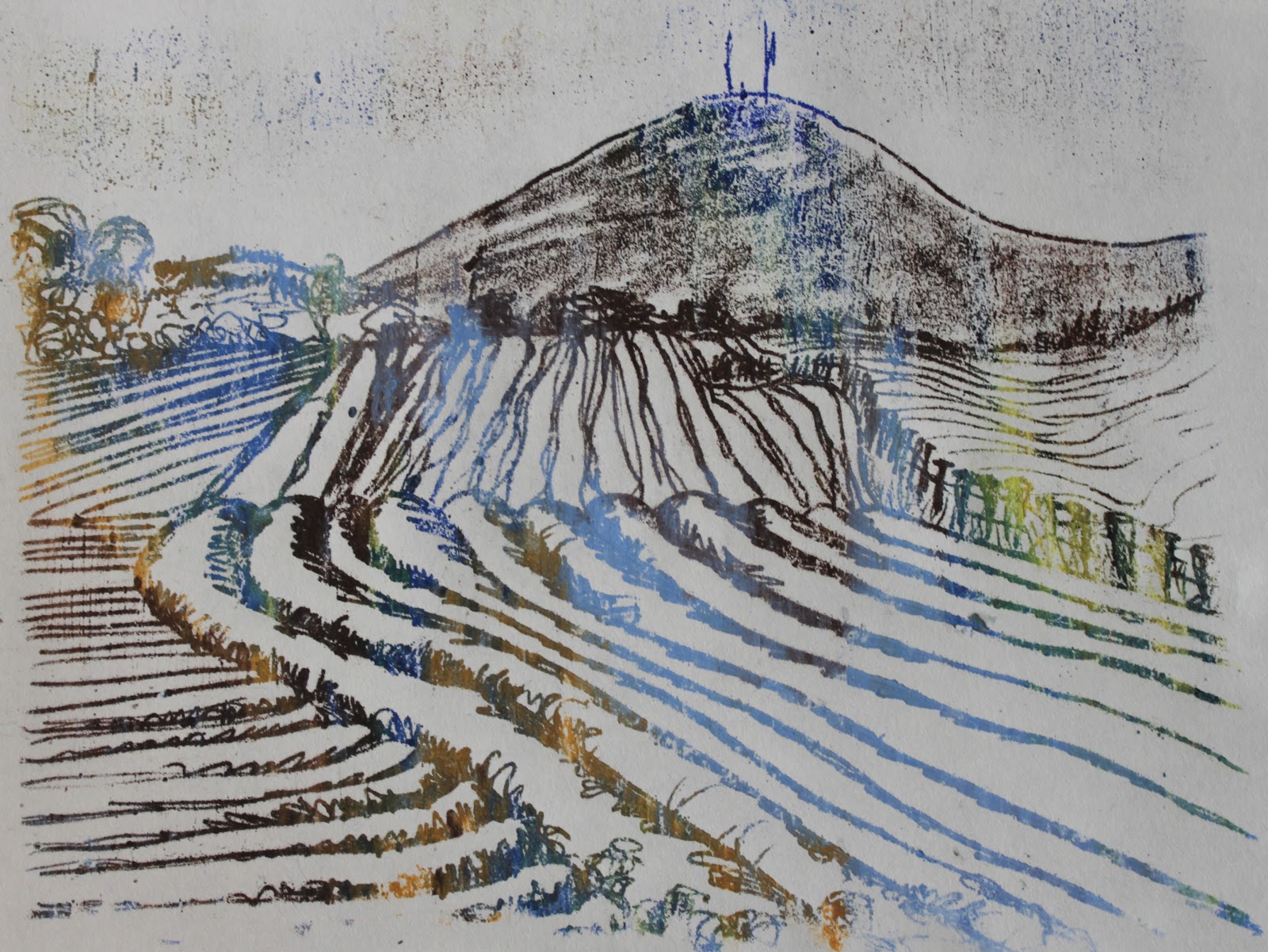
Here's a different subject by Fiona this time, based on plein air sketchbook work of a ploughed field, drawn here using a biro through a soft pastel and oil pastel 'plate' as above.
I'll post a 'how to' with details of materials and photos of the process later this week.
It is a quick outline sketch by Tina (whilst chatting!) of some roses and chrysanthemums. The mark-making is soft and expressive and moves smoothly through different blues and greens. The result is beautifully fresh and spontaneous.
![]() |
| flowers, positive |
| flowers, negative |
The drawings can stand alone as they are, can be used as a basis for further work in oils, or can be developed with other media; for example, with watercolour washes the oil pastel acts as a resist.
If you're not confident about drawing as Tina did directly from a subject, then you can also use this technique with photographs or tracings to excellent effect.
Here's a different subject by Fiona this time, based on plein air sketchbook work of a ploughed field, drawn here using a biro through a soft pastel and oil pastel 'plate' as above.
| landscape, positive |
| landscape, negative |
I'll post a 'how to' with details of materials and photos of the process later this week.
Sunday, 25 November 2012
sketching in Wales
Porthdinllaen in north-west Wales in March this year. A secluded beach, a comfortable cottage right on the shore; clear skies, balmy weather, the sea a smooth sheet of glass reflecting blues from turquoise through azure to ultramarine; daffodils, pale sand and views of distant mountains. Gorgeous.
We travelled on Wednesday and came back on Friday, taking enough paints and paper to last each of us at least a year. Two cars were required to carry it all. The driver who knew the way got lost on the way but quickly recovered. The other driver didn't know the way but followed all the correct roads instinctively.
We sketched and painted all day, fish supper for tea, walked along the beach afterwards by starlight, enjoyed ourselves so much that the next day our sides were hurting from laughing. A wonderful two days.
![]() |
| Sue |
![]() |
| Jane |
![]() |
| Tina |
Click here to see more sketches.
Labels:
art,
drawing,
lleyn peninsula,
mixed media,
painting,
pastel,
porthdinllaen,
sketchbook,
sketching,
wales
Subscribe to:
Posts (Atom)


.jpg)